2025
1244
Maya Voices from Petén and Yucatán: Exploring how Educators and Community Leaders are Preserving Mayan Language
by Juan David Martinez Zayas, Fulbright Scholar, Tinker Field Research Grant recipient, and PhD student in Educational Leadership and Policy Studies, University of Kansas
Introduction
My socio-linguistic and personal journey began on February 1, 2025, when I left Lawrence, Kansas, and arrived in Valladolid, Mexico. From the very start, the vibrancy of the language made itself known - during a taxi ride, the driver and his uncle conversed entirely in Maya. That moment signaled what this research would uncover: a living, breathing linguistic landscape of the everyday life of people in the region under study.
This article presents the findings of fieldwork conducted in Petén, Guatemala, and Yucatán, Mexico, where I interviewed 14 Maya language instructors, activists, and educators to explore their perceptions of their roles in preserving the Mayan language and the initiatives they are leading within their communities. Under a Narrative Inquiry lens, their stories reveal the realities of language teaching, the political-structural obstacles, and the vital role they play in maintaining linguistic and cultural identity.
I believe that the bedrock for preserving an indigenous language in Mesoamerica, like the rest of the continent, is not just a linguistic duty, it is an act of cultural justice.
Preliminary findings:
-Policy Gaps and Persistent Educators: across both countries, a common challenge that emerged is the absence of effective language policies. For instance, in Mexico, Irma Pomol, an experienced instructor and cultural activist, highlighted a contradiction in the nation’s approach. Although Mexico officially recognizes linguistic equality by not declaring an official language, according to her, this often results in a lack of support for indigenous languages- “There is no centralized Mayan linguistic academy,” she explained, - “and no structured teacher training programs.”
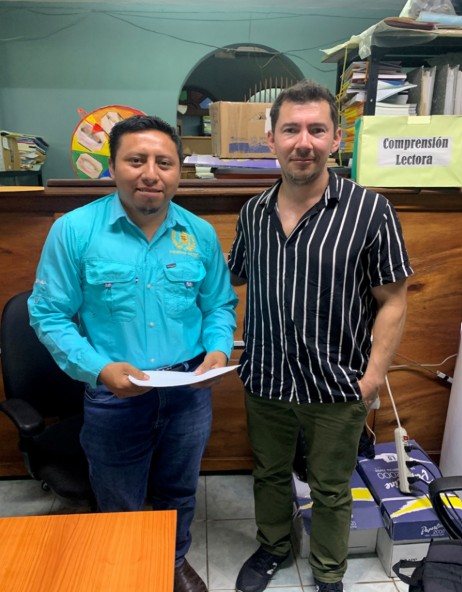
In Guatemala, similar concerns were expressed. Jorge Caal Caal, the director of Indigenous Language Education in Petén, explained that despite efforts by the Ministry of Education to support indigenous language such as Mopan Maya, in San Luis, the lack of trained bilingual teachers limits the work of better language promotion. He stated that “some schools offer Spanish as a language of instruction, and an Indigenous language as a subject because of the lack of qualified teachers in indigenous languages.”
-Community Innovation and Resistance: despite institutional neglect, local educators and activists have created innovative, community-based solutions. In this sense, Didier, a professor in Valladolid, has implemented multiple initiatives to teach Maya. Concerned by the younger generation’s growing separation from their identity, he turned to social media, using Facebook and YouTube, and created original Maya-language songs to reconnect youth with their linguistic heritage.
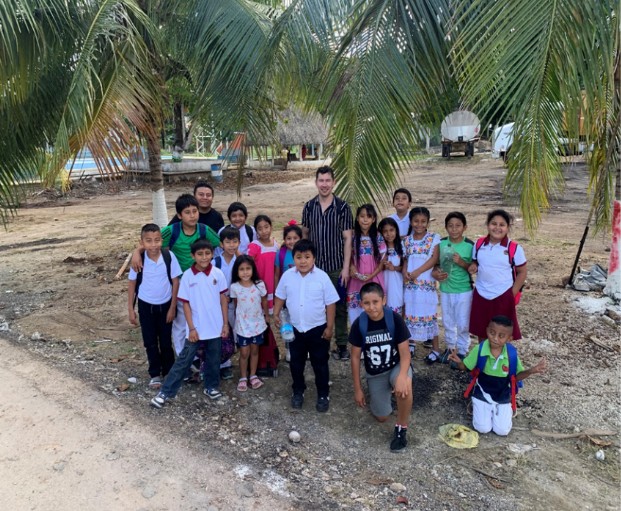
Additionally, in the rural town of Pozo Pirata, I interviewed the only two educators working in the local indigenous school. One of them, Hilario Poot, returned from Cancún after working in the tourism industry and dedicated himself to Maya language teaching. He’s developing a full curriculum written entirely in Maya, incorporating ancestral knowledge and cultural philosophy. “Language preservation depends on local leaders,” he insisted, “not national institutions.”
José Manuel Poot is another Maya teacher and activist who brings together art, philosophy, and ancestral ritual in his work as an artist and researcher. He uses performance to raise awareness of Maya heritage, believing that artistic expression can reach audiences where policy cannot. “Politicians think that Maya is just the pyramids, and they take advantages from the tourism, even worse, we don't have access to these places to do our ceremonies”- he stated.
- Institutional Resistance with Community Roots: the case of Academia de Maya Mopan: in San Luis, Petén, the Academia Maya Mopan has structured community effort to maintain the local language. Founded in 1992 and currently led by Basilia Chiae Cohuj, the academy is staffed by seven professionals working hard to preserve the Mopan Maya language. Their work extends beyond the classroom, including translation, and the publication of books and dictionaries in Mopan.
Basilia shared that the academy has recently shifted its focus from school-based instruction to community-based engagement and inter-generational learning. “We want to ensure that the knowledge of the elders is passed on to this generation, that is why we are working closely with them,” she explained. Her work is reinforced by regional officials like Jorge Caal Caal, who acknowledged the vital role of the academy in keeping Mopan alive. Without it, he noted, “the language, spoken only in this small region, requires an altogether effort.”
A conclusion about Language Teaching as Cultural Resistance
What I observed in Yucatán and Petén is both hopeful and sobering. On one hand, Indigenous languages like Maya and Mopan are under-supported by national systems. On the other, the resilience of educators and community leaders demonstrates that preservation is still possible, even powerful.
From social media campaigns and artistic performances to local language academies, these educators are not waiting for government action to start the step for cultural preservation. They are building the future of their languages themselves. Their stories remind us that language is not only a tool for communication but also a key factor for identity, memory, and resistance.
To support the survival of Indigenous languages, institutions, especially universities, ministries, and local partners, must recognize and invest in these solid efforts. Every indigenous word spoken in the Mesoamerica region today is a clear declaration: we are still here.
Note: David Martinez's field research in Mexico and Guatemala was co-funded by the Tinker Foundation and KU College of Liberal Arts & Sciences. The Tinker Field Research Grant is administered through the Center for Latin American & Caribbean Studies at KU.
Students form the school Javier Rojo Gomez in the indigenous community of Pozo Pirata, Yucatan, Mexico.
Picture with Jorge Caal Caal, the director of Indigenous Language Education of the Department of Education in Peten, Guatemala.